
Developing global research partnerships is essential for advancing knowledge, solving complex challenges, and ensuring equitable access to innovation, especially in an interconnected world. It also has the potential to enhance research visibility and influence, amplified innovation, and resource efficiency.
In an increasingly interconnected world, global research partnerships are essential for addressing complex challenges that transcend borders. These collaborations foster innovation, enhance knowledge exchange, and leverage diverse expertise, ultimately driving impactful solutions to pressing global issues, such as climate change, public health crises, and technological advancements.
It is equally important to know what you bring to the table during international research collaborations.
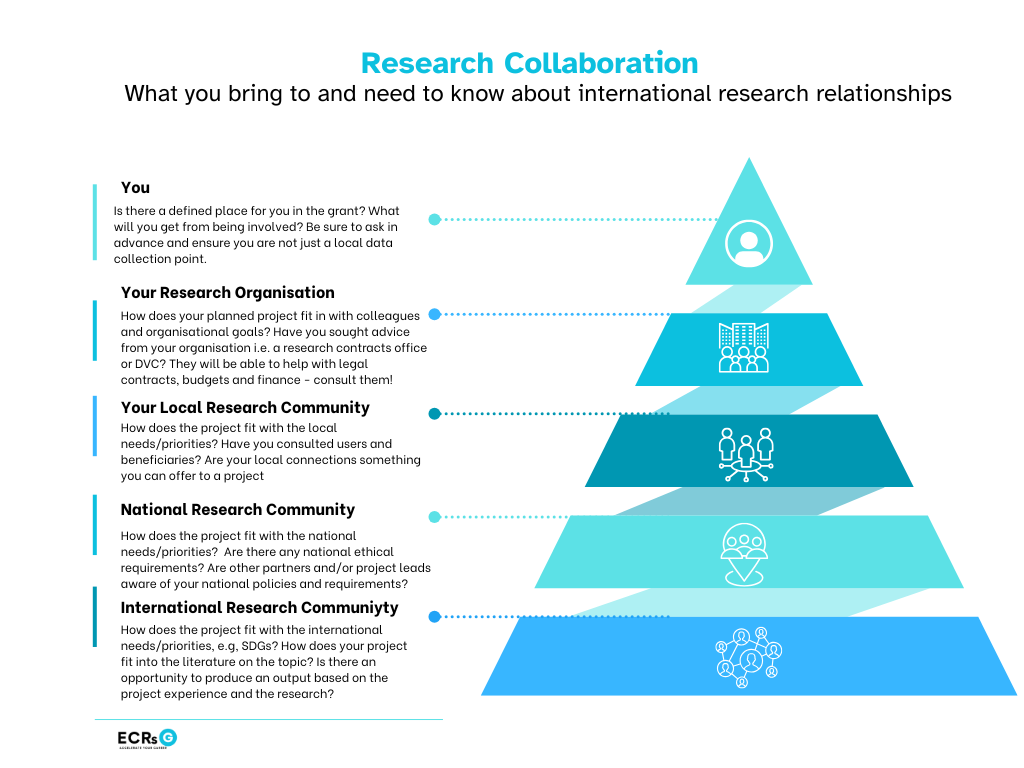
Pooling resources and expertise through global partnerships can significantly enhance efficiency. Researchers can share data, laboratories, and funding opportunities, reducing redundancy and maximizing the impact of their work. This collaborative approach can lead to cost savings and faster project completion times
Building Global Partnerships – some things to consider in your preparation and planning
- Definition – What are Global Partnerships?
- Rationale – Why is a global partnership needed?
- The Partnership:
- Who are the like-minded researchers you can partner with?
- Where can they be found?
- Develop a way of working to support collegial working – e.g. Who owns the data? What happens when things go wrong? How will authorship be determined?
- Purpose – What are your motivations for starting one? Establish the purpose of the partnership.
- Background – Who else is already undertaking a partnership with this purpose?
- Collaboration – Who could add value as a result of being a part of this partnership?
- Developing core competencies – What skills are needed for effective global research collaborations?:
- Communication and building networks
- Cultural competency and contextual awareness
- Relationship building
- Project Management and coordination
- Challenges to global partnerships – What barriers present themselves when engaging global partners?
- Strategies for mitigating challenges to building global partnerships – How can challenges be overcome?
- Resources Mobilisation – What resourcing will be required to facilitate and build global partnership?
– Monetary funding
– Funding agencies
– Research expertise – Identify what research expertise is required. (What is already in existence?)
– Logistical needs
10. Strategic planning – Utilise the point above as a starting point to generate a plan of action.
11. Strategic evaluation – Create checkpoints at every stage to ensure the partnership keeps to its stated aims. Adjust as needed.
Additional Resources
National Centre for Universities and Businesses
https://www.ncub.co.uk/insight/building-bridges-through-international-collaboration
British Council
https://arts.britishcouncil.org/projects/international-collaboration-grants
UKRI
https://www.ukri.org/what-we-do/international-funding/how-we-support-international-collaboration
The BRECcIA Way: Inclusive and equitable international research
Here is an animation and podcast on The BRECcIA way – an inclusive international research consortium:

Download this training resource on Corporate communication best practices and find out more about how to communicate effectively.
Corporate Communication Best Practices.pdf
Download this training resource on Mastering Communication and Presentation Skills to make outstanding performances.
Mastering Communication and Presentation Skills

The Association of Commonwealth Universities has co-created useful and practical tools for every step in international research projects. The Equitable Research Partnerships Toolkit
Articles
Sowah, Winnie N.A. ; Jayson-Quashigah, Philip Neri M. ; Atiglo, Donatus Yaw et al (2025). ‘Unleashing Potential: Collaborative Research as a Catalyst for Capacity Building and Enhancement’ in Oceanography.Vol. 38, No. 1. https://doi.org/10.5670/oceanog.2025.112